
Deworming your pet is an integral aspect of pet care. While nearly 85% of kittens and puppies are born with parasitic infections, most animals develop immunity over time. However, illness and stress can weaken the body’s response to fight off these parasites and can awaken any dormant larvae living in your pet.
Intestinal parasites affect growth and development and can be transferred between pets and pet owners. If you think your pet might be suffering from a parasitic infection, we can perform a fecal examination to detect microscopic parasite eggs or a fecal antigen test to detect adult worms in the intestinal tract.
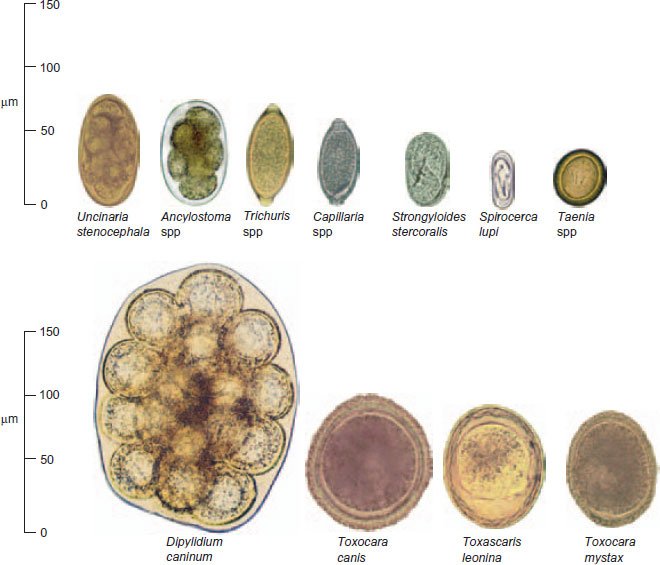
Figure: Microscopic parasite eggs found in dogs and cats feces
Administering Anthelmintic Drugs (Dewormers)
It is important to know what type of parasite your pet has before administering an anthelmintic (parasite killing drug). This is because different medications are needed for different parasites. Unfortunately, anthelmintic drugs have been used indiscriminately and sometimes inappropriately, which has allowed the worms to develop resistance to the medications. As a result, it is becoming more and more difficult to eliminate worm infestations. You should only administer an anthelmintic after a positive diagnosis of intestinal parasitism under the direction of a veterinarian. It is also important to administer the medication in the correct dose and to repeat treatment at the correct interval to kill all worms. While the anthelmintic is a poison meant to directly target the parasites, pets weakened by a parasitic infection might be too fragile for the toxicity of the medication and an overdose is possible if directions are not followed.
How to control parasites
Parasites are known for their ability to continually re-contaminate their host. In order to control parasites, destroying the eggs and larvae or removing them from the environment before re-infestation is critical. To achieve this, pet owners must maintain clean and dry living areas for their pets.
Pets should be encouraged to defecate in areas that are easy to remove waste from, wash out, and keep clean such as cement or gravel. Dirt and grass should be avoided when possible. Pet waste needs to be removed daily, and fleas need to be exterminated.
Phone: (636) 583-3066
Monday 7:30 AM–5:30 PM
Tuesday 7:30 AM–5:30 PM
Wednesday 7:30 AM–5:30 PM
Thursday 7:30 AM–5:30 PM
Friday 7:30 AM–2PM
Saturday 8 AM–12 PM
Sunday Closed