
While nursing, pets receive antibodies and nutrients from their mother’s milk. When nursing stops, pets become more susceptible to illnesses because their immune systems do not have the same support they once did. As part of a preventative care routine, pet vaccinations can help protect your pet from life-threatening diseases. These same vaccinations also protect your family from zoonotic diseases: diseases that animals can transmit to people!
For most pets, routine vaccinations start around the age of 6 to 8 weeks. Several booster vaccines are given every 3-4 weeks until your pet reaches immunologic maturity around 4 months of age. Then boosters are administered annually throughout adulthood. Some vaccinations are combined into a single syringe so your pet experiences fewer injections. Some vaccines are even given orally. Until a young pet reaches immunologic maturity, they should stay isolated from heavily populated areas like dog parks, boarding facilities and grooming locations. Full immunity to vaccinations develops approximately 14 days after the final booster vaccine. This is when it becomes safe for them to begin to socialize with other pets and frequent those locations. Pets who have been vaccinated have an advantage over those who have not. When an infectious virus or bacteria is encountered, your vaccinated pet’s immune system quickly responds, decreasing severity of the illness or preventing it altogether.
Pet owners should note that vaccinations are preventative, not curative. A vaccination will prevent an illness, but if your pet is already suffering from a disease, a vaccine will not cure them.
There are several pet vaccinations that are necessary for all pets and others that are recommended only under special circumstances. Core vaccinations are those that are commonly recommended for all pets, and non-core vaccinations include those that are only administered to pets considered to be “at-risk.” Necessary vaccines depend on local regulations, geographic location, and your pet’s lifestyle. Your pet will be vaccinated according to their risk of exposure. Your veterinarian will discuss the best options for your pet.
Rabies – The rabies vaccine is considered a core vaccine, and many states require pets to have it by law, but there are a few exceptions. The initial vaccine is first given when the puppy reaches 16 weeks old. A booster shot is necessary after 1 year, then typically every year following that.
Distemper, Hepatitis, Parainfluenza, Parvovirus (DHPP) – These vaccines are considered core vaccines. Your puppy will receive their first vaccination between 6 and 8 weeks old. Booster shots will be given once every 3 to 4 weeks until your puppy is 16 to 18 weeks old (depending on when vaccinations were started). Adult dogs will receive two doses of this vaccine initially. A booster vaccination is administered after the first year and every year following that.
Coronavirus – This virus is considered a core vaccine for all puppies. Two doses of this will be given with the DHPP during your puppies vaccination series. It is not generally given to adult dogs.
Bordetella (kennel cough) – This is a non-core vaccine, but your veterinarian might consider your pet to be at risk. The vaccination is first given to puppies when they are 9 weeks old. The new oral vaccine now only needs to be given once a year. Dogs that require this vaccine are those that are exposed to other dogs. If your dog goes to the groomer, a kennel, a trainer, or dog park, this vaccine is strongly recommended. You should also consider this vaccine if you live in a subdivision with a large dog population or travel with your pet to areas with lots of dogs like state parks.
Leptospirosis – This non-core vaccine is given to puppies as part of their puppy series. This vaccination is intended to prevent bacterial infections in the kidneys, liver, and other major organs. Dog’s contract Leptospirosis by coming into contact with water that has been contaminated with infected urine from wildlife. If your dog is exposed to puddles, ponds, or roadside ditches that wildlife have access to, this vaccine would be recommended. Keep in mind, humans can contract this infection, so preventing this infection in dogs is very important. Annual booster vaccines are recommended. Unfortunately, a significant number of dogs develop allergic reactions to this vaccine. In those cases, this vaccine is avoided in the future.
Lyme – The Lyme vaccination is a non-core vaccine that is not routinely recommended in Missouri. If you will be travelling to an area of the country where Lyme disease is more common, you might consider vaccination. Strict tick control will also prevent this infection. As long as a tick does not stay attached for 24 hours, transmission of the Lyme bacteria cannot occur.
Canine Influenza – This is also a non-core vaccine. it is recommended for dogs that will travel to parts of the country where this virus is more common like Florida or Chicago. It is also recommended for dogs that will be exposed to dogs that have travelled from those part of the country and are brought together in places like parks or boarding facilities.
Rabies – This vaccine is a core vaccination for cats and kittens. The initial vaccine is first administered between 12 and 16 weeks of age. A booster shot is necessary after 1 year, then typically every year following that.
Feline Herpesvirus, Calicivirus, Feline Distemper – These vaccines are considered core vaccines. Your kitten will receive their first vaccination between the ages of 6 and 8 weeks, and they will need to be repeated once every 3 weeks until your kitten reaches 14 weeks of age (depending on when vaccinations were started). Adult cats will receive two doses of this vaccine initially, three weeks apart. A booster vaccination is administered annually to all cats.
Feline Leukemia (FeLV) – Feline Leukemia is a non-core vaccine. The disease is most frequently seen in stray cats and multi-cat households. Because of this, the vaccination is only recommended for cats that go outside or cats that share food bowls, litter boxes, and mutual grooming with other cats of unknown feline leukemia status. Cats and kittens must receive two doses of this vaccine initially. Then a booster is given annually. Since there is a very reliable test for this viral infection, all new introductions to a household should be tested before vaccination is considered.
Similar to human vaccinations, pet vaccinations do carry a risk of side-effects. While negative side-effects do exist, it is important to note that your pet is statistically more likely to develop a life-threatening illness when not vaccinated, than to suffer adverse results from a vaccination. None-the-less, it is important to remain informed so you can ask your veterinarian the appropriate questions at your pet’s appointment.
After being vaccinated, the injection site can be swollen or sore. Some pets also have a reduced appetite, fever, and experience lethargy. These side-effects should diminish over the next 24 to 48 hours. If you notice your pet’s side-effects are not subsiding, please contact our office. Very rarely, pets develop an allergy to a vaccine. Allergies can be detected within minutes of receiving a vaccination and if left untreated, very rarely result in death. If you witness any of the following, contact our office immediately: collapse, non-stop diarrhea, continual vomiting, difficulty breathing, itching, or swelling of the legs or face.
Regulations regarding rabies vaccinations
We are located in Missouri, where there are no exemptions. All dogs and cats must be vaccinated for Rabies in our state!
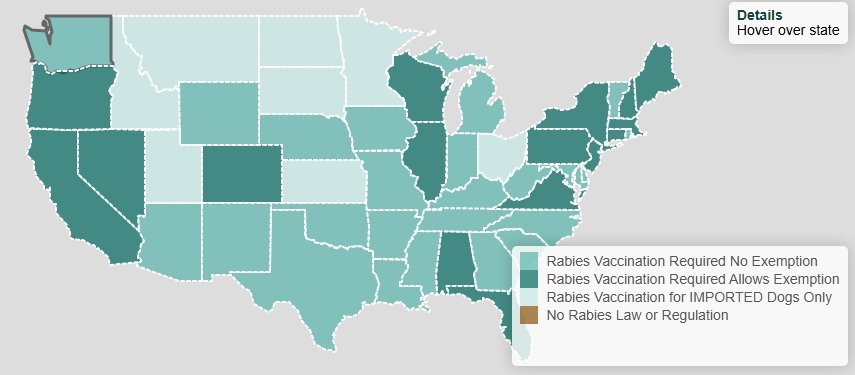
While the federal government does not mandate pet vaccinations for rabies, most states implement their own laws regarding pet vaccination. Vaccination laws also vary from country to country, so if you plan on moving, be sure to check necessary requirements to ensure a smooth transition for your family.
States in which your pet can receive exemption from being vaccinated include: Alabama, California, Colorado, Connecticut, Florida, Illinois, Maine, Nevada, New Hampshire, New Jersey (dogs only), New York, Oregon (dogs only), Vermont, Virginia, and Wisconsin. All other states require rabies vaccinations by law – for all pets.
If you have any questions about vaccinations or scheduling new pet vaccinations, you may contact our office at your convenience.
Compassionate pet care for over 30 years — keeping pets healthy and owners satisfied.
Mon–Thu 7:30 AM – 5:30 PM
Friday 7:30 AM – 2:00 PM
Saturday 8:00 AM – 12:00 PM
Sunday Closed